Cavity-assisted nonlocal metasurfaces for momentum-space broadband-operational optical vortice generation with maximum efficiency approaching 80%
Co-first author
Research overview
Problem
Momentum-space singularities enable vortex generation in nonlocal metasurfaces, but steep high-Q dispersion limits bandwidth and conversion efficiency.
Mechanism
A Fabry-Pérot cavity controls coupling between bound states in the continuum (BICs) and degeneracy points, tuning dispersion, radiative Q and polarization into quasi-flat bands with strong scattering.
Result
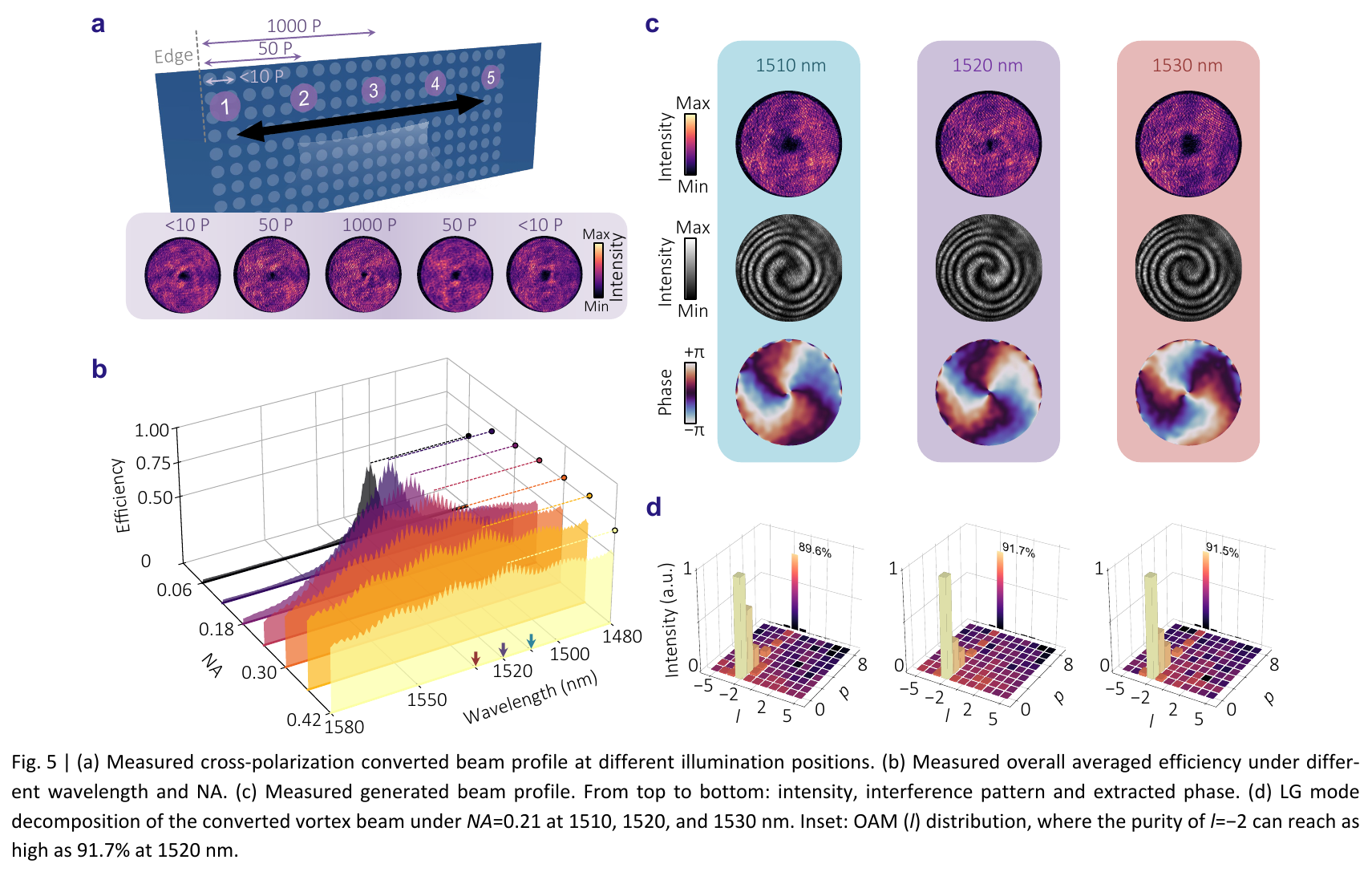
In Figure 5, efficiency peaks at 77% for NA = 0.24 at 1520 nm. Under the separate conditions of NA = 0.21 at 1520 nm, the l = −2 orbital-angular-momentum purity reaches 91.7%.
- Journal
- Opto-Electronic Advances
- Year
- 2026
- DOI
Preview versionPublished article · OEA 9, 250296 (2026). The preview starts at the article's first page, after the publisher's cover and front matter.
Turning momentum-space singularities into a vortex converter
Generating phase winding is only part of the problem: light must also convert efficiently over a finite bandwidth and angular range. One mechanism figure and one experimental figure connect the design choices to observations and measurement conditions.
Designing dispersion and radiation together
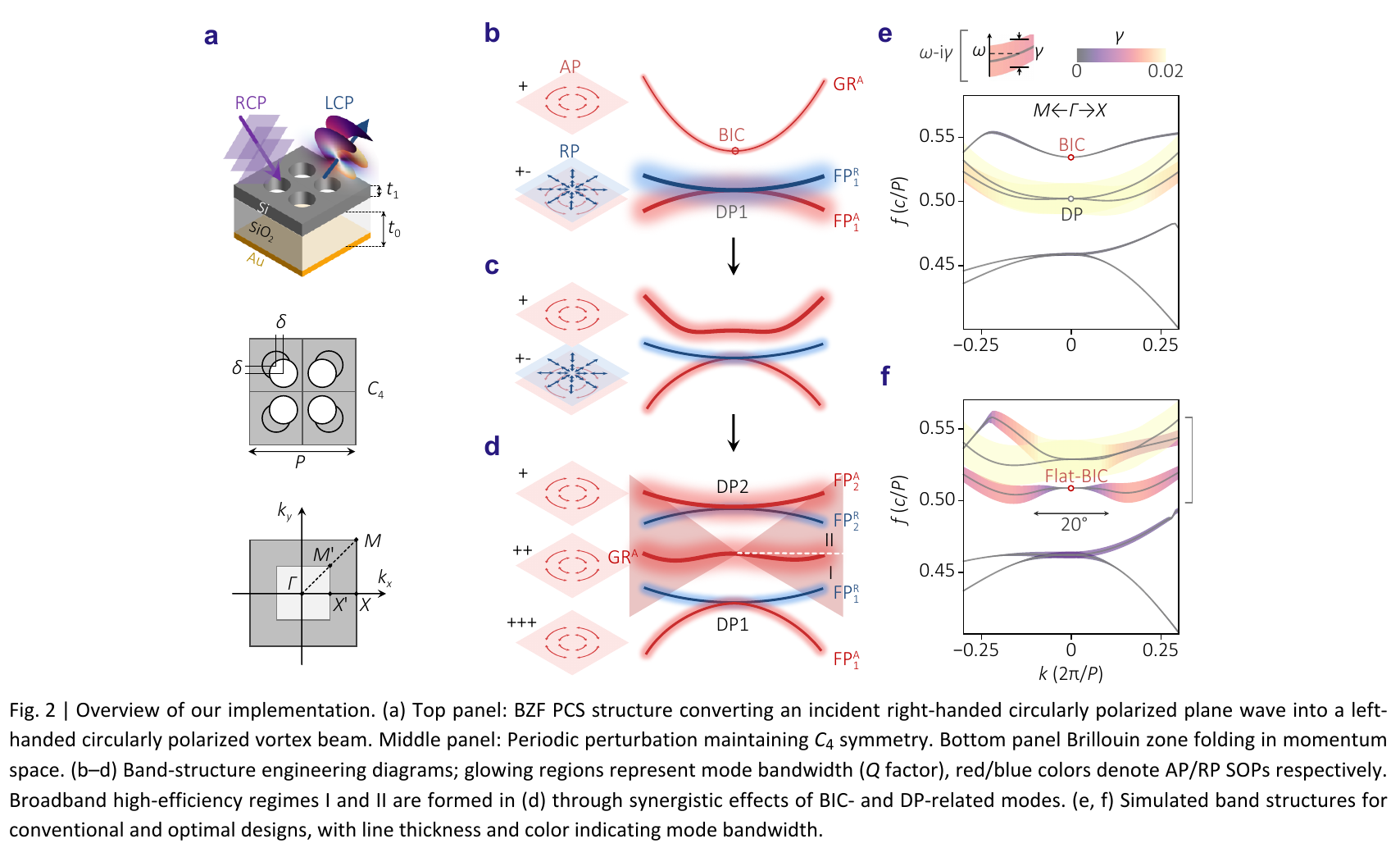
Figure 2 combines a silicon photonic-crystal slab, a silica spacer and a gold mirror. The spacer forms a tunable Fabry-Pérot cavity; periodic perturbation preserving C4 symmetry introduces Brillouin-zone folding and guided resonances. Coupling BIC- and degeneracy-point-related modes changes dispersion, radiative linewidth and polarization together, producing the two broadband high-efficiency regimes in Figure 2(d). Figures 2(e) and 2(f) compare simulated bands of conventional and optimized designs.
Reading the experimental numbers with their illumination conditions
Figure 5(a) compares illumination positions from near the edge to the center; Figure 5(b) measures overall averaged efficiency across wavelength and NA. The text reports a 77% peak at 1520 nm for NA = 0.24, with efficiency above 60% over ±25 nm around that wavelength. Figures 5(c) and 5(d) show beams, phase and LG-mode decomposition at NA = 0.21; the l = −2 purity reaches 91.7% at 1520 nm. These observations examine position dependence, operating range and vortex-mode composition separately.
From a mechanism figure to measured evidence
Together, these figures connect topological singularities and tunable mode coupling to device behavior under finite illumination conditions. Figure 2 contains structural schematics and numerical bands; Figure 5 contains experimental measurements. The 77% efficiency and 91.7% purity have distinct NA and wavelength conditions, rather than being universal specifications. This site's software tracking example uses independent synthetic data and is not presented as a computation used in this paper.
Related reading
Structured coherent thermal emission from non-Hermitian metasurfaces
Resonance and radiation control in non-Hermitian metasurfaces for coherent thermal emission with directionality and polarization structure.
Anomalous spontaneous emission enhancement by bound states in the continuum in nonlocal metasurfaces
Investigating the relationship between bound states in the continuum and enhanced spontaneous emission in nonlocal metasurfaces.
High-Q resonance engineering in momentum space for highly coherent and rainbow-free thermal emission
High-Q resonance engineering in momentum space for highly coherent, rainbow-free thermal emission.